


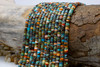

Description
- Approximate beads per strand: 186
Spiny Oyster:
- What is it: Spiny oyster, also known as Spondylus, is not actually an oyster but a colorful bivalve mollusk found primarily in the warm waters of the Pacific Ocean, especially along the coasts of Mexico and South America. Its shell comes in striking hues of orange, red, and purple, sometimes blending into dramatic patterns. Jewelers and artisans often cut and polish the shell into beads, cabochons, or inlay pieces. Because of its vibrant colors and natural sheen, spiny oyster is widely used in Southwestern, Native American, and Latin American jewelry.
- History:
Spiny oyster has a long history of use in indigenous cultures, dating back thousands of years. The Inca, Aztec, and other ancient civilizations valued it as a sacred material, using it in rituals, offerings, and adornments. It was often considered a symbol of fertility, vitality, and connection to the sea. In the American Southwest, Native tribes, including the Zuni and Navajo, have long incorporated spiny oyster into their jewelry, often alongside turquoise and silver. Its cultural role as both an adornment and a spiritual offering has preserved its importance through the centuries, making it a continuing favorite in traditional and contemporary jewelry design. - Metaphysical Properties:
In the metaphysical realm, spiny oyster is thought to carry the energy of the ocean, embodying adaptability, creativity, and emotional strength. The orange and red varieties are believed to stimulate passion, courage, and vitality, while the purple hues are linked to intuition, wisdom, and spiritual awareness. Many practitioners use spiny oyster as a grounding and protective stone that helps balance emotions and connect the wearer to the rhythms of nature. It is also said to enhance personal expression and bring joy and resilience, much like the vibrant shell itself.
Turquoise:
- What is it: Natural turquoise is a copper-rich mineral admired for its beautiful range of blues and greens, often accented by a striking matrix from the host rock. Its smooth polish and unique patterns make it highly desirable for jewelry, carvings, and ornamental use. Chinese turquoise, in particular, is known for its variety of hues and distinctive spiderweb-like veining, giving each piece a one-of-a-kind character.
- History: Turquoise has been cherished across cultures for thousands of years. In Egypt, it was mined as early as 3000 BCE in the Sinai Peninsula and used to craft jewelry, amulets, and inlays for royal tombs. In Persia (modern-day Iran), turquoise was considered a national stone, widely used to decorate palaces, mosques, and crowns, symbolizing protection and wealth. In the American Southwest, Native tribes such as the Navajo, Zuni, and Hopi regarded turquoise as sacred, incorporating it into jewelry, ceremonial tools, and talismans for protection and guidance. In China, turquoise has been carved and worn for centuries, often associated with prosperity, spiritual balance, and artistic expression. Each region developed its own traditions around turquoise, but all viewed it as a powerful stone of beauty and significance.
- Metaphysical Properties: Turquoise is widely regarded as a stone of protection, truth, and healing. It is believed to strengthen communication, inspire honesty, and bring emotional stability to its wearer. Many see it as a calming stone that balances energy, dispels negativity, and fosters courage during challenges. Its soothing colors are linked to peace of mind and spiritual awareness, making it a favorite for meditation and self-expression. Across cultures and centuries, turquoise has been valued not only for its striking appearance but also for the sense of harmony and strength it is said to bring.
Because shells and gemstones are natural materials, appearances may vary from bead to bead.
Additional Information
Material: |
Turquoise |
Dimensions: |
2x4mm |
Shape: |
Wheel |
Finish: |
Polished |
Approx. Strand Length: |
15.5 inches |
Sold: |
By the strand |
Color: |
Blue |
Hole Size: |
1mm |
Material: |
Spiny Oyster |
Range: |
4-5.9mm |
Color: |
Orange |
Range: |
2-2.9mm |
Related Products
Related Products


Natural Turquoise Spiny Oyster Polished 6mm Coin
Bead World Gems
kr908.67
Approximate beads per strand: 64 Spiny Oyster: What is it: Spiny oyster, also known as Spondylus, is not actually an oyster but a colorful bivalve mollusk found primarily in the warm waters of the...


Natural Turquoise Spiny Oyster Polished 8mm Coin
Bead World Gems
kr1,206.76
Approximate beads per strand: 48 Spiny Oyster: What is it: Spiny oyster, also known as Spondylus, is not actually an oyster but a colorful bivalve mollusk found primarily in the warm waters of the...

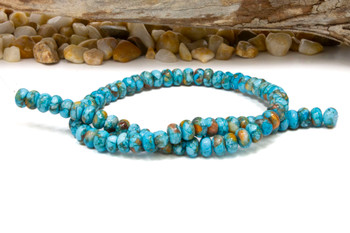
Turquoise and Spiny Oyster Reconstructed Polished 8x5mm Rondelle
Bead World Gems
kr572.13
Approximate beads per strand: 77 Spiny Oyster: What is it: Spiny oyster, also known as Spondylus, is not actually an oyster but a colorful bivalve mollusk found primarily in the warm waters of the...


Turquoise, Spiny Oyster, and Pyrite Polished 4x6mm Rondelle
Bead World Gems
kr1,014.45
Approximate beads per strand: 112 Spiny Oyster: What is it: Spiny oyster, also known as Spondylus, is not actually an oyster but a colorful bivalve mollusk found primarily in the warm waters of...