
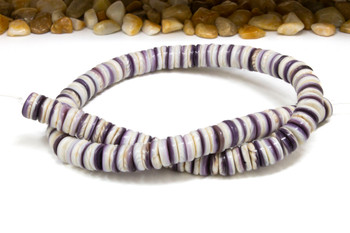
Wampum Shell and Spiny Oyster 8mm Heishi
- Weight:
- 51.00 Grams


Description
- Approximate beads per strand: 124
- Wampum:
- What is it: Wampum refers to beads traditionally made from the inner parts of quahog and whelk shells, which produce deep purples, whites, and blues. These beads are small, cylindrical or tubular in shape, and highly polished, often strung together into belts, necklaces, or decorative items. Beyond their beauty, wampum holds cultural significance and is considered both an art form and a symbolic medium rather than simply a material for adornment. Because of the difficulty in working the dense shells, wampum beads have always been valued for the craftsmanship involved in their creation.
- History: For centuries, wampum was created and used by Native American tribes, especially those in the Northeastern Woodlands such as the Iroquois and Algonquin peoples. Wampum belts served as records of treaties, agreements, and historical events, with the patterns of white and purple beads conveying meaning and narrative. Contrary to popular misconception, wampum was never simply “money” in the European sense; rather, it was a sacred medium of communication, authority, and remembrance. After European colonization, wampum was sometimes used as a form of exchange, but its deeper cultural significance as a record-keeping and ceremonial tool has always remained central.
- Metaphysical Properties: Spiritually, wampum shells are believed to carry energies of truth, communication, and balance. Many view them as tools for connecting to ancestral wisdom and honoring traditions. The purple and white hues are thought to represent duality and harmony, dark and light, life and death, earth and spirit. Wampum is also associated with clarity of thought, honesty in expression, and protection during transitions. While its primary importance is cultural and historical, those who use it in a metaphysical context see it as a grounding and guiding material that strengthens both personal integrity and collective bonds.
- Queen Conch:
- What is it: Queen conch (Lobatus gigas) is a large marine mollusk native to the warm waters of the Caribbean, the Bahamas, and parts of Florida. Its shell is famous for its soft pink interior, while the exterior often shows a cream to tan surface with natural ridges. Beyond its culinary use in island cuisine, the queen conch shell is highly valued for ornamental carving, jewelry, and decorative art. When polished, the pink interior can display a subtle iridescence, making it a desirable material for cameos and beads.
- History: The queen conch has been important to many cultures for centuries. In the Caribbean and Bahamas, it has long been a dietary staple, with shells repurposed as tools, trumpets, or ceremonial objects. In South and Central America, archaeological sites reveal that conch shells were carved into ritual artifacts and used as musical instruments in sacred ceremonies. In Europe, particularly during the 18th and 19th centuries, queen conch shells were imported and meticulously carved into cameos, which became fashionable adornments in fine jewelry. In Asia, conch shells (including queen conch) have held spiritual significance in Hindu and Buddhist traditions, symbolizing purity, longevity, and the divine sound of creation. This broad historical use across continents highlights the conch’s dual role as both a practical resource and a sacred object.
- Metaphysical Properties: Metaphysically, queen conch is believed to embody the gentle yet powerful energy of the sea. It is associated with emotional healing, intuition, and harmony, helping to calm the mind and encourage compassion. The soft pink coloration resonates with the heart chakra, often linked to love, self-care, and nurturing energy. Some view queen conch as a symbol of new beginnings and spiritual awakening, using it to connect with oceanic energies and cycles of renewal. As both a natural treasure and a spiritual tool, it is seen as bringing peace, resilience, and balance to those who work with it.
- Spiny Oyster:
- What is it: Spiny oyster, also known as Spondylus, is not actually an oyster but a colorful bivalve mollusk found primarily in the warm waters of the Pacific Ocean, especially along the coasts of Mexico and South America. Its shell comes in striking hues of orange, red, and purple, sometimes blending into dramatic patterns. Jewelers and artisans often cut and polish the shell into beads, cabochons, or inlay pieces. Because of its vibrant colors and natural sheen, spiny oyster is widely used in Southwestern, Native American, and Latin American jewelry.
- History:
Spiny oyster has a long history of use in indigenous cultures, dating back thousands of years. The Inca, Aztec, and other ancient civilizations valued it as a sacred material, using it in rituals, offerings, and adornments. It was often considered a symbol of fertility, vitality, and connection to the sea. In the American Southwest, Native tribes, including the Zuni and Navajo, have long incorporated spiny oyster into their jewelry, often alongside turquoise and silver. Its cultural role as both an adornment and a spiritual offering has preserved its importance through the centuries, making it a continuing favorite in traditional and contemporary jewelry design. - Metaphysical Properties:
In the metaphysical realm, spiny oyster is thought to carry the energy of the ocean, embodying adaptability, creativity, and emotional strength. The orange and red varieties are believed to stimulate passion, courage, and vitality, while the purple hues are linked to intuition, wisdom, and spiritual awareness. Many practitioners use spiny oyster as a grounding and protective stone that helps balance emotions and connect the wearer to the rhythms of nature. It is also said to enhance personal expression and bring joy and resilience, much like the vibrant shell itself.
Because shells are natural materials, appearances may vary from bead to bead.
Additional Information
Material: |
Spiny Oyster |
Color: |
Orange |
Shape: |
Heishi |
Finish: |
Polished |
Dimensions: |
8mm |
Approx. Strand Length: |
15.5 inches |
Hole Size: |
.5mm |
Sold: |
By the strand |
Range: |
8-9.9mm |
Related Products
Related Products


Wampum Shell and Spiny Oyster 10mm Heishi
₹9,459.80
Approximate beads per strand: 108 Wampum: What is it: Wampum refers to beads traditionally made from the inner parts of quahog and whelk shells, which produce deep purples, whites, and blues...


Turquoise & Spiny Oyster 8mm Heishi
Bead World Gems
₹8,509.07
Approximate beads per strand: 144 Spiny Oyster: What is it: Spiny oyster, also known as Spondylus, is not actually an oyster but a colorful bivalve mollusk found primarily in the warm...
Orange Spiny Oyster 8mm Heishi
₹2,139.15
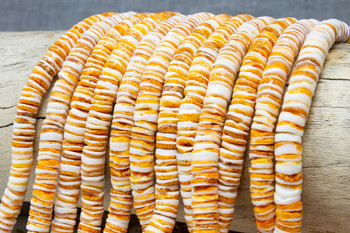
Approximate beads per strand: 300 What is it: Spiny oyster, also known as Spondylus, is not actually an oyster but a colorful bivalve mollusk found primarily in the warm waters of the Pacific Ocean,...

Wampum Shell 12mm Heishi
₹6,132.23
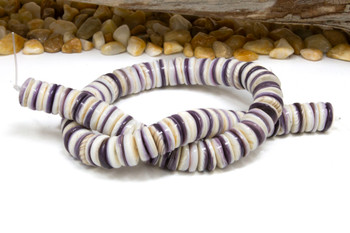
Approximate beads per strand: 120 What is it: Wampum refers to beads traditionally made from the inner parts of quahog and whelk shells, which produce deep purples, whites, and blues. These beads...
Wampum Shell 10mm Heishi
₹5,656.87
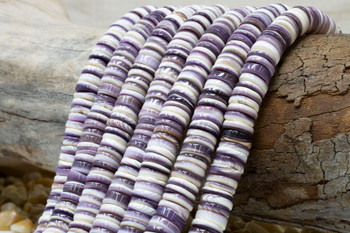
Approximate beads per strand: 108 What is it: Wampum refers to beads traditionally made from the inner parts of quahog and whelk shells, which produce deep purples, whites, and blues. These beads...